Why speed-to-lead wins trade shows
Leads go cold fast. Here's what the research on response time tells us, and how to follow up while the conversation is still fresh.

Founder & CEO
Airley
Featured

Every conversation on your stand has a shelf life. The prospect who was genuinely interested at 2pm on day one has, by the following week, spoken to a dozen other exhibitors, caught up on a backlog of email and moved on to the next priority. The longer you wait, the more your follow-up has to compete with everything that happened since.
That's what speed-to-lead is about: shrinking the gap between a real conversation and your first meaningful follow-up.
What the research says
The most widely cited study on response time comes from Harvard Business Review ("The Short Life of Online Sales Leads", 2011). Researchers audited how quickly over 2,000 US companies responded to web leads. They found that firms which tried to contact a lead within an hour were nearly seven times as likely to qualify that lead as firms that waited even one hour longer, and dramatically more likely than those that waited a day or more. Among companies that did respond, the average response time was 42 hours.
That study looked at inbound web leads, not trade shows. But the principle carries over: interest decays, and the first relevant, well-timed message tends to set the agenda for everything that follows.
Why events make speed harder
You're still on the stand. The busiest hours for conversations are the worst hours for writing emails.
Context is scattered. Badge scans, business cards, phone notes and memory rarely end up in one place.
Everyone follows up at once. When the show ends, every exhibitor hits the same inboxes in the same week.
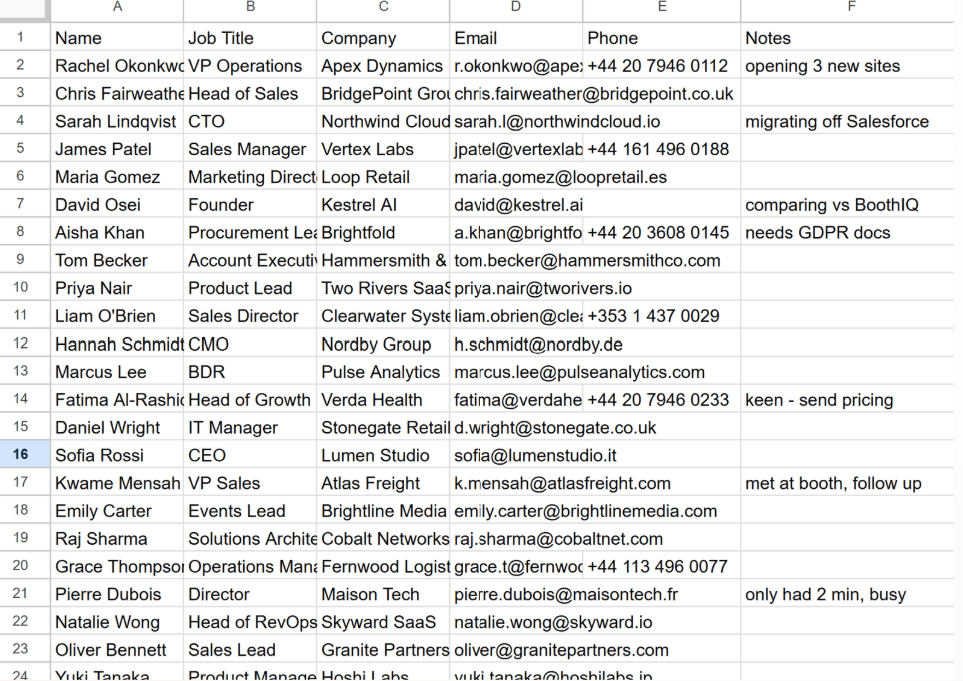
Data entry comes first. Leads often wait in a spreadsheet until someone has time to clean them up and import them.
How to follow up while it still matters
Capture context in the moment. Thirty seconds after each conversation, note the pain point, what you promised and the agreed next step. A voice note is faster than typing.
Send something useful the same day. A short, specific message that references your conversation beats a polished one that arrives next week.
Plan the sequence before the show. Decide your follow-up steps across email, LinkedIn and calls in advance, so on the day you're only filling in the personal detail.
Get leads into your CRM immediately. If a lead isn't in the system, it isn't owned by anyone.
Where Airley fits
Airley is built for exactly this gap. Snap a badge or record a voice note on the stand, and Airley enriches the contact, drafts a personalised follow-up based on what you actually discussed and syncs it to your CRM, so your first follow-up can go out while the conversation is still fresh.